Studio Tours: Wein, Roberts, and Arcone
Dive deeper into the creative process of three artists featured now in our main gallery!
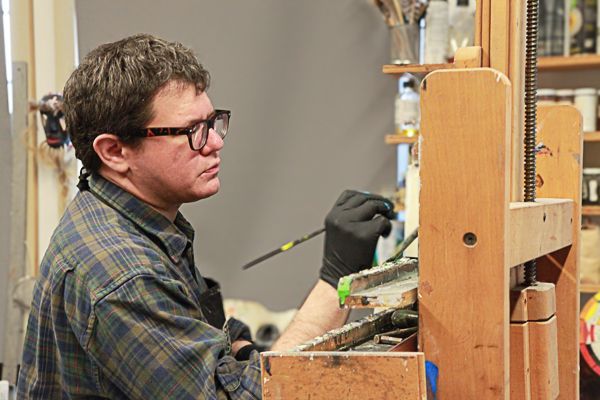
An artist’s studio is a deeply personal space in most cases. It’s a place where you can hone in on a new technique, see your ideas come to life, find unexpected inspiration, or learn something new about your art and yourself.
Three of the artists we’re
currently displaying in our main gallery have provided us with a glimpse into their own creative processes from the impetus behind their collections to the specific methods they used to produce their work!
Natasha Wein
Natasha Wein describes If These Feet Could Fly, as “a memorial of what's been lost and a declaration to remain open to life, love, and possibility despite unrecoverable damages.” Being struck by a car resulted in a traumatic brain injury (TBI) while Wein was already experiencing complications from hypermobile Ehlers-Danlos Syndrome (hEDS). Prior to the accident, Wein experienced sporadic difficulty in using her hands to paint, and the TBI only complicated things. She became extremely sensitive to light, developed excruciating migraines, and found herself in a new and vulnerable position of dependence.
These “honest stories of grief and joy,” reflect the full spectrum of emotion and physical adaptation Wein achieved throughout her journey to regain independence and freedom as she once understood them. In describing her process for this collection, Wein noted that she tries to find answers to questions like, “what happens when the body deteriorates in new and unexpected ways before the heart is ready, and how do you live a meaningful life when wounded beyond repair?”
Wein is quite inventive when it comes to her method in answering those questions. Beyond painting with her feet, which sounds unconventional in and of itself, she colored canvases on the floor of her studio with wash and paint, then stepped over them with sandals fastened together out of cardstock. Once flipping the cardstock over, she had a finished piece. Wein also used objects like the bike helmet - credited for saving her life in the accident - or plastic fruit wrappers to create distinct textures and markings with paint, mimicking things like tire marks.
Talia Roberts
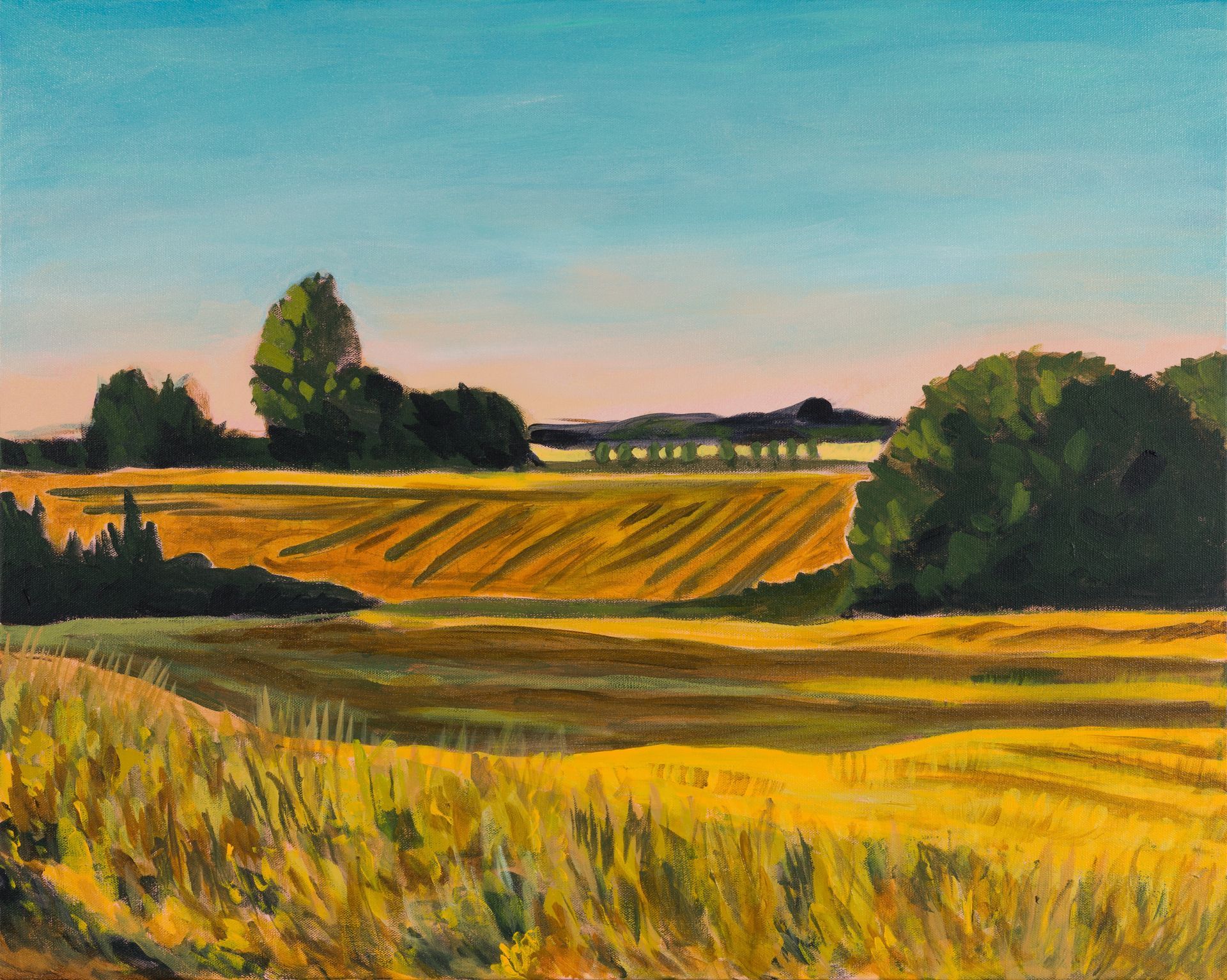
A similar spirit of invention is found in Talia Roberts’ collection, Earth Memories, Moon Visions. Born out of her desire to avoid potentially harmful components of traditional oil paints, Roberts develops her own using walnut oil, white marble dust, and natural pigment from plants, soil samples, and crushed rocks.
The title of her collection is inspired by her custom medium. “Using locally sourced materials allows each painting to carry the memory of a place,” noted Roberts. “The paintings all share a reoccurring circular motif, the image of a moon to explore duality and the relationship between the real tangible world and the cosmos connecting the rocks with the stars.”
Roberts first had the idea to use these materials from her home in Vermont while working in the garden. Having already started the process of getting closer to nature by working with plants and growing her own food, it made sen`se for this to be the next step in her artistic evolution. Roberts uses a hammer, mortar and pestle, a lengthy filtering process, and a glass muller and slab to achieve a finished product. Her process is a simple labor of love - she even starts and finishes her paintings in one sitting, taking around 5 hours to complete and resulting in a unique finish once completely dried.
Steve Arcone
Keeping with the theme of the natural world, Steve Arcone, photographer and retired research geophysicist, describes Chamber’s Pond as his “main studio.” His macro photography subjects range from ice formations to spider webs to the laminar flow of oil on water. His Icescapes in the Abstract collection is part of a dual exhibition in our main gallery alongside Roberts’ Earth Memories, Moon Visions.
Arcone’s work allows the viewer to experience wintery waters in a new light. Using a macro lens allows him to produce images with “almost no depth of field.” His scientific training and professional background have informed his ability to interpret the structures captured in his work: “The patterns these [ice] formations make - either by repetition or because of nearby synchronous growth - are what make my abstract compositions.”
If you’d like to learn more about how Arcone blends art and science in his work, we encourage you to attend our
Artist Talk with him on Friday, September 4!