Interview with Exhibiting Artist Jackie Brown

Peili Heitzman • April 30, 2026

Jackie Brown 


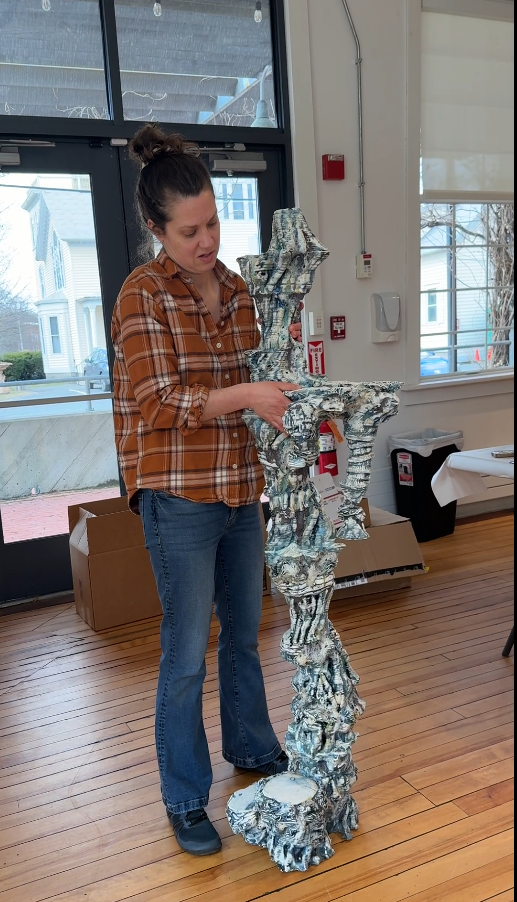
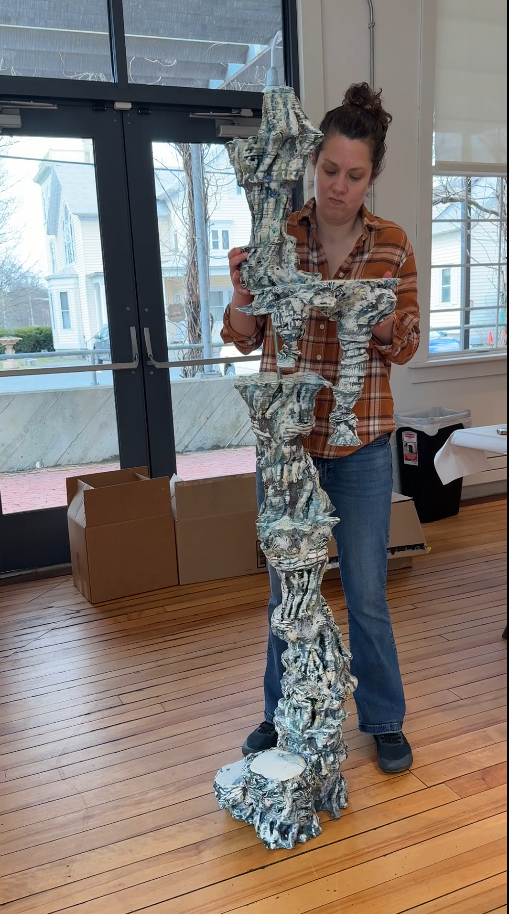
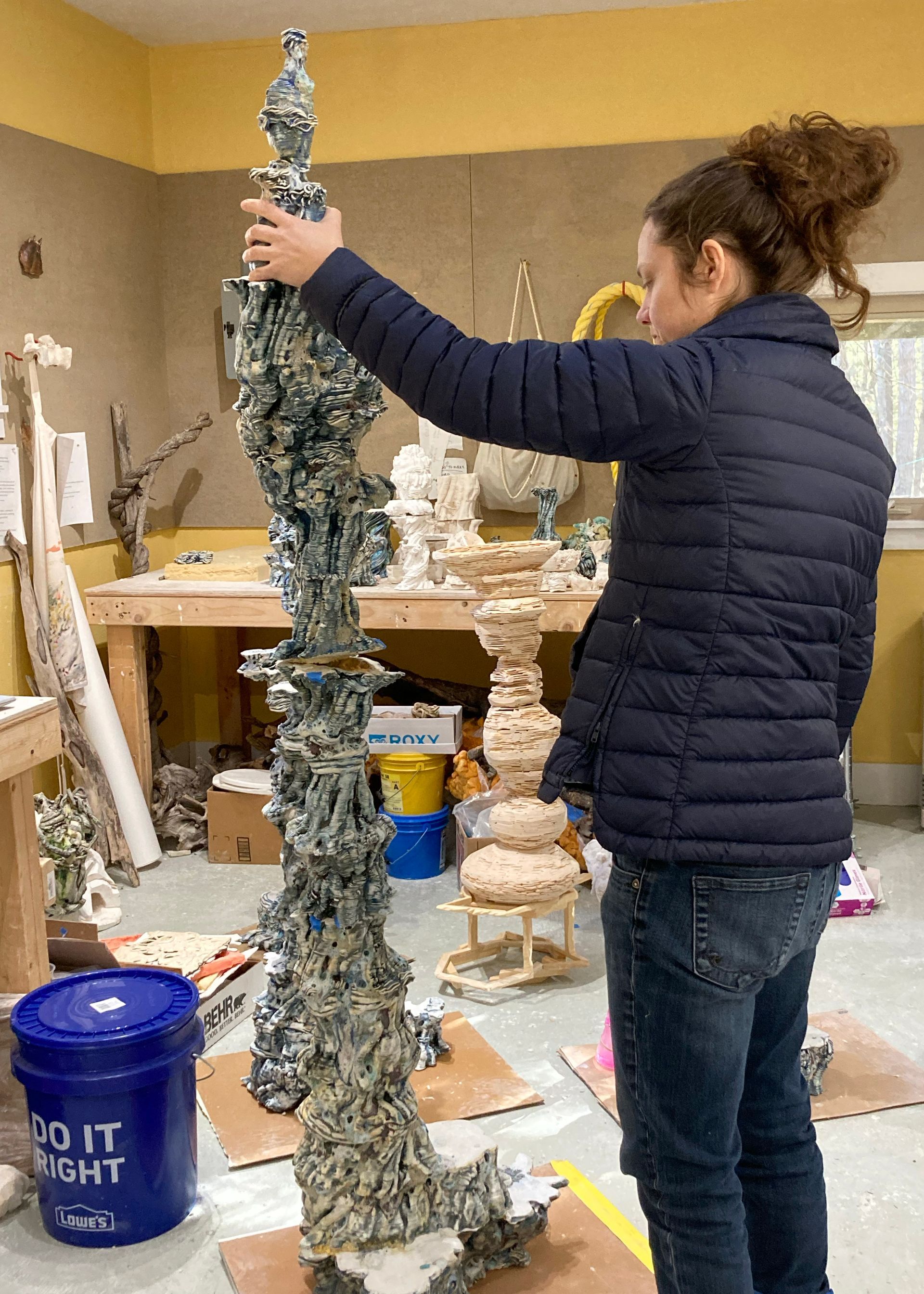
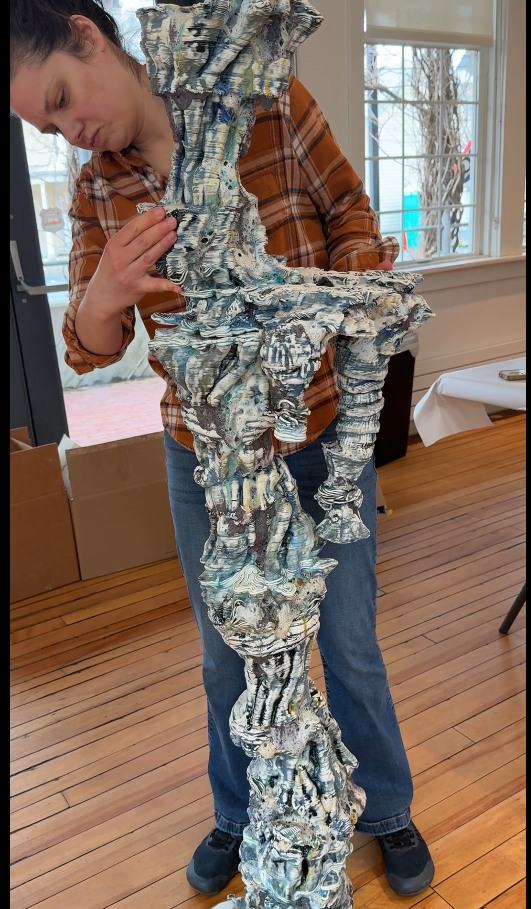
After a long trek from Maine and the exciting frenzy of her exhibition install, exhibiting artist Jackie Brown sat down with us in AVA’s Rebecca Lawrence Gallery to share her journey as a ceramicist. Brown’s experimentation with form, material, and process has been an evolving practice through which she has reflected and investigated her world in flux. Changes in seasons, the environment, growth, decay, petrification, come to life in her sculptures. As much as they tell a story about our natural world, her work reflects the artist’s innovation with 3D modeling, molds, and AI technology that have become fundamental tools in her work. At the intersection of nature and technology, Brown’s work is intricate and otherworldly. Her exhibit “Fault Lines and Foundations” will be on view at AVA until May 23rd, she will also be hosting an artist talk on May 23rd from 3-4. You won’t want to miss it!

Peili Heitzman: When did you first start making art?


Jackie Brown: I was always interested in making art, you know, as a kid and growing up, but it was in college. I first started taking art classes, sculpture classes, ceramic classes, and making art in a more serious way and thinking about the possibility of pursuing a life as an artist and what that might look like, and if that might be possible.


PH: Can you tell us about your journey to clay?


JB: I went to Hamilton College for undergrad and they had an amazing ceramics program. So that was where I sort of first became fascinated by ceramics and all the different ways that it can be used and explored and I really loved the way it was challenging. I knew I would never be bored working with clay and ceramics. There was always more to learn about – the chemistry, the processes, the different states of the clay, the different temperatures and kinds of clay and firing processes. I love the challenge of it, and I love how broad and vast it is. 


PH: Can you talk about your process of creating sculpture with clay? And then can you talk about your process and the 3D printing element? 


JB: I would say clay, it's the material I keep coming back to as an artist. Because it is so malleable and it's a shape shifter and it has this limitless potential to change and transform. And so, I really love that about it, and then that informs how I approach the process. I work a lot with molds, clay will mimic anything, so I make a lot of plaster and silicone molds where I can produce multiples. But then, because clay is wet and malleable, I can combine parts while the clay is still wet, and I can work with lots of molds and then replicate the same parts over and over again but then combine them in endless variations. So, I love having these constants and these variables. 3D printing became another way to create parts. When you make a mold, you can replicate the same part repeatedly, and when you 3D print you can as well replicate parts, but because of the process- 3D printing extrudes clay- so it's different every time; clay has a mind of its own. I love that potential to replicate these parts and play and then combine them in different ways. Because of the malleability of the clay, I can squish parts together, I can push from the inside out, I can combine parts while they're wet, I can fuse parts together in the kiln. There's all this different potential for transformation.


PH: Your work revolves around exploring geological change in living systems. Is there a specific place you've been to or lived in that inspired this curiosity and exploration of nature?


JB: I don't know if there's a specific place but spending a lot of time outside. And there's something about New England. I grew up in New England; there's something about the seasons here. There's something about being in one place, year after year, and watching those small, subtle changes of growth in transformation, occur and recur. 


PH: Much of your process intersects human creation with technology. How has the collaboration with technology in AI transformed or changed your process?


JB: For me, it just feels like more possibilities. I think of AI as a tool, the same way I think of a band-saw as a tool or a car as a tool. I'm interested in how those tools can allow for different possibilities. Multiple tools augment and expand the possibilities within an experimental process.


PH: Can you recall a piece of advice you received from a teacher or mentor that has stuck with you today? 


JB: There are so many! One is to just get out of your own way. For me, if I plan too much or get to set on how something's going to come out, I tighten up, and I become a perfectionist. And so, I created strategies in my process that allow me to experiment and discover form rather than preconceive the form. That's a way of getting out of my own way. 


PH: As a teacher yourself, what advice would you give to a young artist, emerging in the art world today? 


JB: To engage in process and to build a relationship with your work, because that's what will sustain you. If you have genuine creative practice that you're nurturing, you'll be able to weather any storms that come at you. And to resist that urge to feel like you must constantly be churning out and sharing new things on social media or out in the world. Give things the time they need to take shape
October 30, 2026
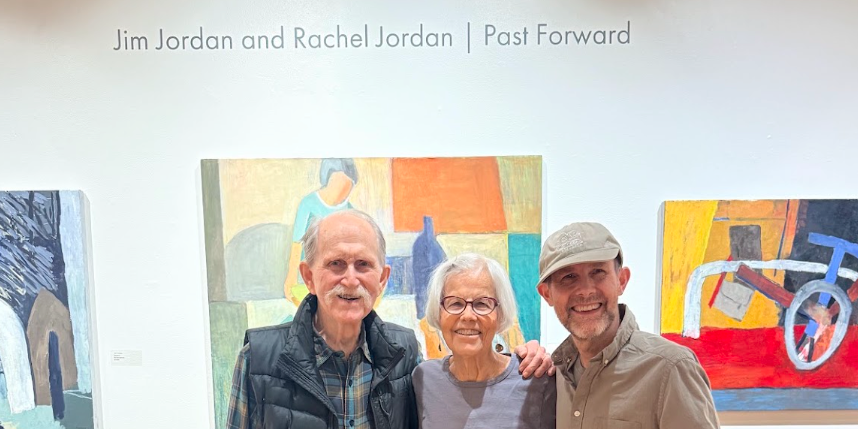
A Family of Artists: Meet Rachel, Jim, and Chris Jordan We were fortunate to host the entire Jordan family this month at AVA! Rachel, Jim, and their son, Chris, are a great example of art as a family affair! But what does that look like in practice? For The Jordans, it's a shared appreciation for art, the creative process, and the experiences that shape the way each of them sees the world. Rather than creating art as a singular unit, Rachel & Jim consider the family to be “three related artists each working separately on their own.” While they don’t share projects, they absolutely share an appreciation for creativity and even some influences! This family is a fine example of including artistic expression as a core family value. Beyond that, they’re impressive creatives, each in their own right. And our favorite reason for working with them is that they’re just really, really great people. We hope you enjoy getting to know them better, and be sure to stop by to see Rachel and Jim’s current exhibition, Past Forward , in our main gallery - on view now through November 14!  A History of Creativity The Jordans’ artistic roots extend well beyond the three of them. Rachel had several visual artists among her relatives on her father's side, while her sister initially studied art before pursuing a career in modern and ballet dance, eventually teaching at Hunter College in New York City. Jim's family also had its share of creative talent, including a sister who was a musical prodigy on piano, a mother who was a talented vocalist, and relatives interested in decorative arts. Both Rachel and Jim demonstrated an early aptitude for drawing and painting. For the Jordans, shared experiences also shaped creativity. As they explained, "All of our trips abroad (and many in the US) have focused on art and architecture." Many were also connected to Jim’s art history work. Their family's tradition of summer camping also helped cultivate a shared appreciation for the visual world of nature. Although each family member developed an individual creative practice, there was a common understanding that art required both imagination and dedication. Hard work, patience, and persistence were recurring values in their approach to their craft. A Family Portrait with Different Perspectives While the Jordans share an appreciation for the arts, they each have their own creative identity and process. Rachel and Jim share a studio and are familiar with each other's painting practices, but they’re also intentional about maintaining their individual creative spaces. As they explained, "We respect each other's privacy while working and only offer critiques on request." The couple’s artistic influences overlap in some areas, particularly their studies of early twentieth-century modernism. Both recognize the influence of Cézanne and the Cubists, including Picasso and Braque. Chris's creative pursuits took a somewhat different direction, spanning both photography and music. His interest in photography began with a home darkroom in the basement and eventually led him to graduate school and a career in higher education. He taught at Sage Colleges before becoming a tenured photography professor at the University of Alabama. In 2021, he published Nowhere in Place , a book featuring his work. Music had also been a consistent part of Chris's creative life. His early interests included trumpet, singing, and electric bass, with his focus shifting between music and photography over the years depending on his surroundings, work, and creative collaborations. Interestingly, the roots of his band, Eleventh-Hour Collective, which recently performed at AVA, could be traced back to high school, when he first played with the guitarist who was now part of the group. When asked whether his parents had ever inspired a song or another piece of art, Chris explained that the influence was often indirect and difficult to pinpoint. "Yes, but indirectly," he shared. "For me, inspiration can be a mysterious process; it's hard to pin down specific connections." He described creativity as a combination of memories, ideas, and associations that could unexpectedly come together in a tangible form. Sometimes, he recognizes familiar melodies, rhythms, shapes, or compositional elements in his work that may have been unconsciously influenced by people or other artists. Chris also shared a wide range of artistic and musical influences. In photography, he particularly enjoyed the work of Minor White and Carl Chiarenza, artists whose approaches to photography explored the sublime through subtlety. He also named Roni Horn, Hiroshi Sugimoto, and Gregory Crewdson among the artists who had influenced him. His musical influences were just as varied, including The Beatles, 1970s Miles Davis, Weather Report, Rush, Kate Bush, and David Bowie. Lessons from Each Other It’s clear that even though Chris has a wide variety of artistic influences, Rachel and Jim have also played a big role in the development of his artistic method. When asked what lessons his parents had taught him about art and life, Chris's answer was simple: patience and practice. "Patience and practice! It's important to learn the materials, methods and language of your craft," he explained. For Chris, developing technical ability is about more than mastering a medium. It’s about learning how to use it to translate inspiration into something tangible and, hopefully, relatable to an audience. He connected this idea to the Zen Buddhist concept of "chop wood, carry water," describing the creative process as something that required consistent effort and everyday practice. "Sometimes there can be dramatic fireworks of inspiration, but most often the process is a slow burn," he said. He saw a similar lesson in life itself, emphasizing the importance of showing up, living well, loving others, and remaining open and vulnerable. As he put it, "Living the day-to-day moments, showing up, living well, loving others, being open, vulnerable, not too armored and protective." It was a philosophy that echoed the values Rachel and Jim also recognized in their own artistic practices. When reflecting on the lessons art had taught them, they shared, "Patience and persistence are probably art's biggest 'life lessons.'" For Chris, the important part of being a creative person was developing the practice and technical skills necessary to be ready when inspiration arrived. He believes those moments can’t be forced. They might come as "a spontaneous gift from the muses, or after long hours of fruitless toil." Either way, the work was in being prepared to recognize and act on them. Favorite Memories For Chris, one of his favorite memories of family creativity went back to childhood and the family's tradition of making Christmas ornaments together. "This one's easier!" he said when asked about a favorite family creativity memory. One year, they cast plaster ornaments of Paris and painted them. Rediscovering those ornaments each year remained something he enjoyed, particularly because of the intricate painting and the family's collection of favorites. Some, he noted, were even a little hilarious. It was a simple tradition, but one that reflected the family's longstanding connection to making art and creating together. While Rachel, Jim, and Chris each follow their own creative paths, their stories shared common threads like having a deep appreciation for the art + the process, a willingness to put in the work to see their visions through, and an openness to be inspired by whatever an appreciation for art and its history, a willingness to put in the work, and an understanding that creativity was shaped by both the people and experiences around them.
By Lars Hasselblad Torres • September 21, 2026
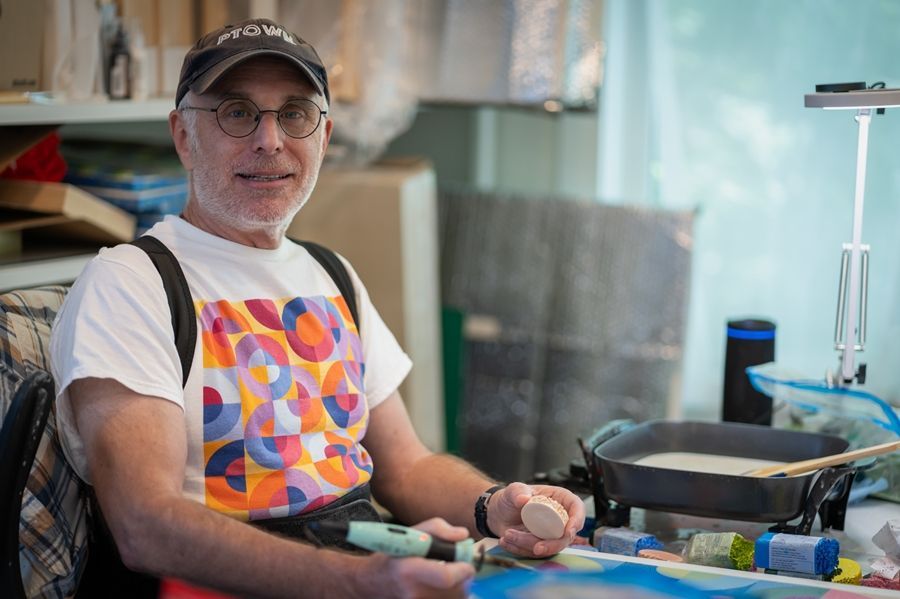
Photo of Ross Ozer in his studio by Jen Zee for the Provincetown Independent (2026)
By Claire Geno • September 21, 2026
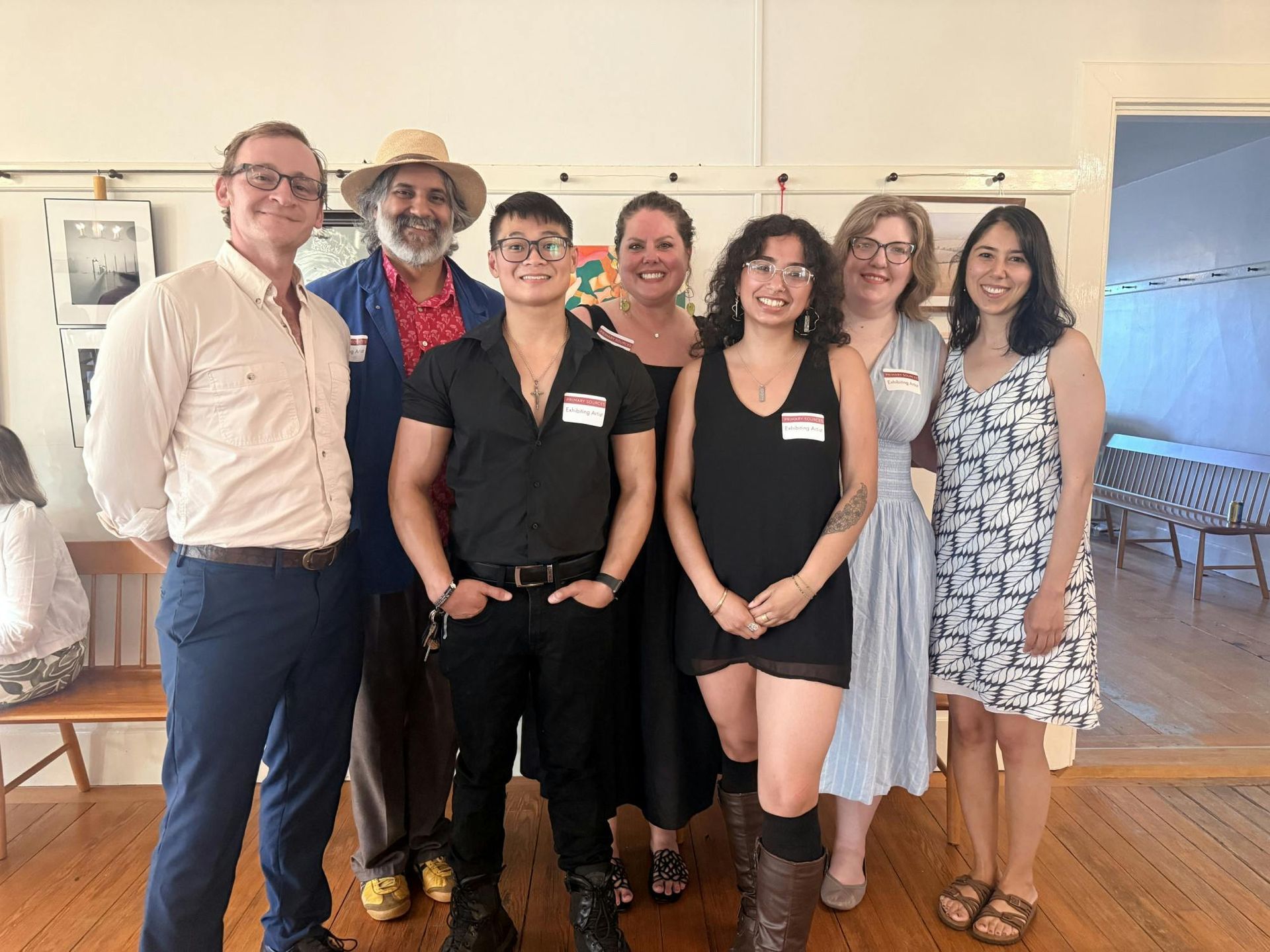
The Alliance for the Visual Arts’ Young Artists Meetup is a free group for Upper Valley artists early in their careers looking for support and camaraderie.