Interview with Exhibiting Artist Jackie Brown

April 30, 2026

Jackie Brown 


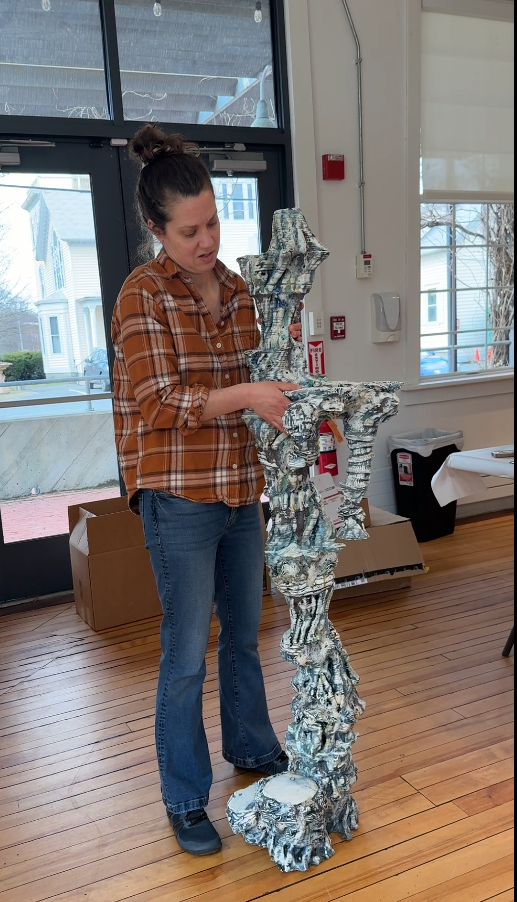
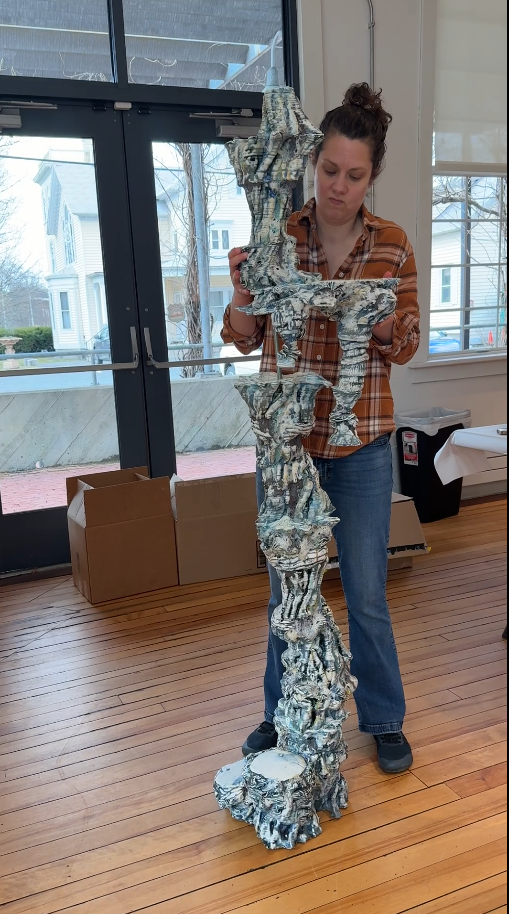
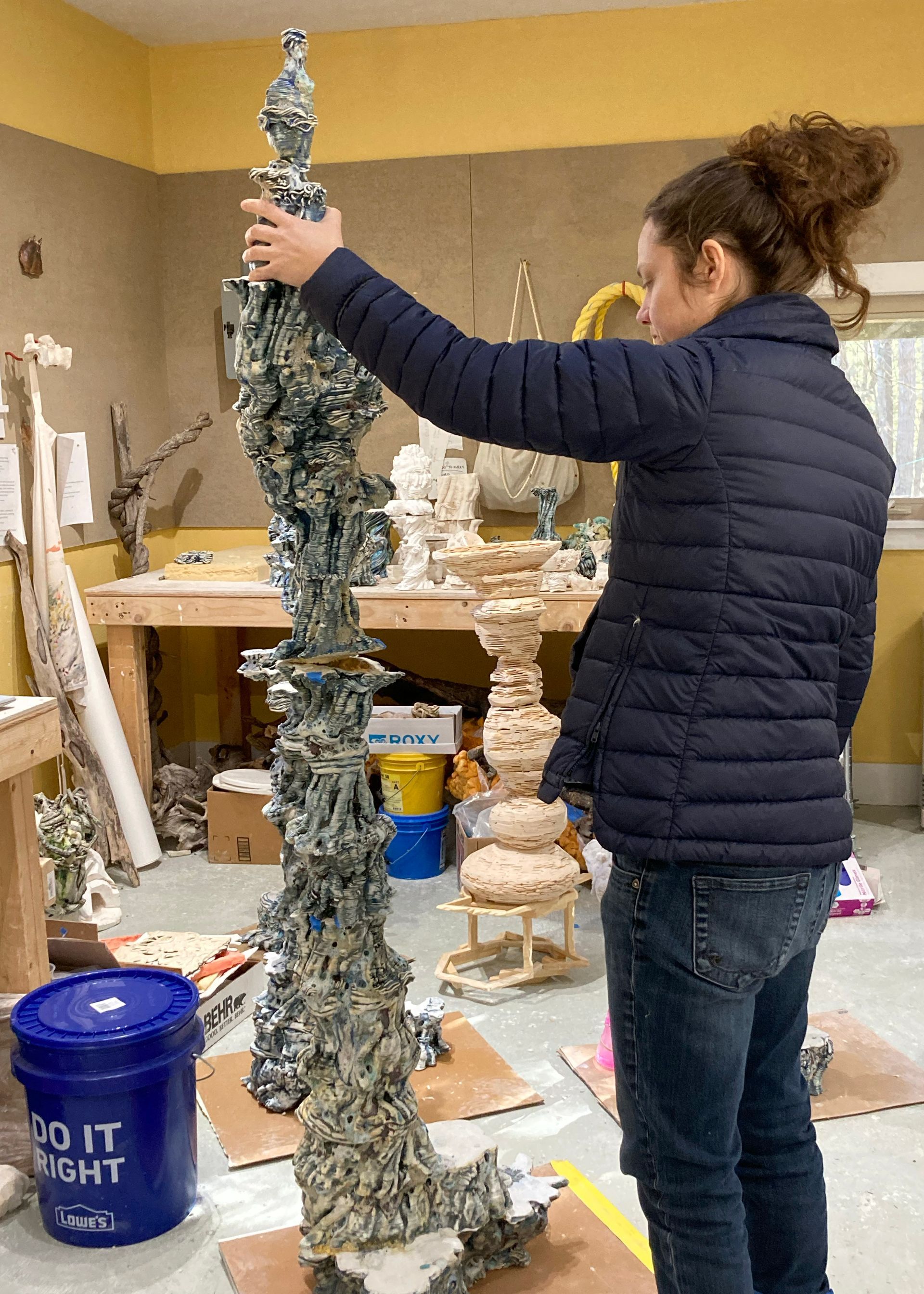
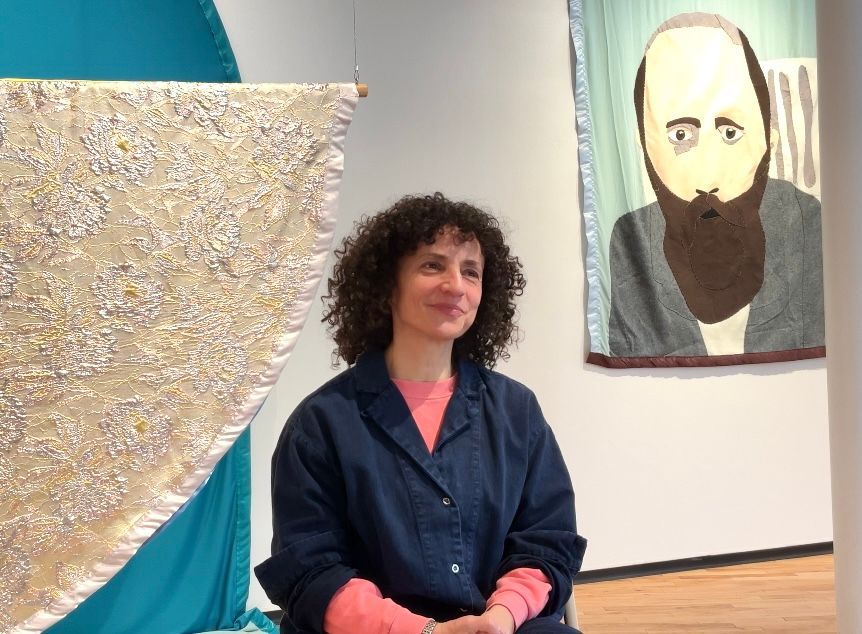
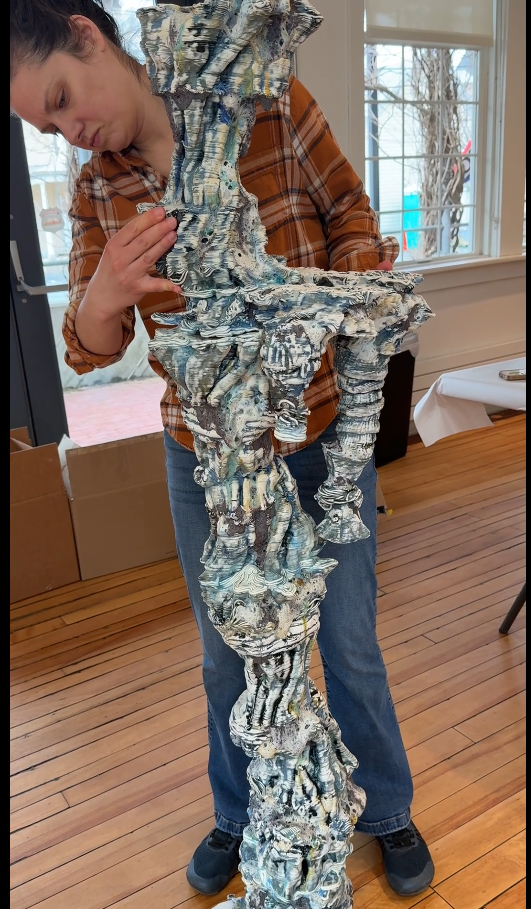
After a long trek from Maine and the exciting frenzy of her exhibition install, exhibiting artist Jackie Brown sat down with us in AVA’s Rebecca Lawrence Gallery to share her journey as a ceramicist. Brown’s experimentation with form, material, and process has been an evolving practice through which she has reflected and investigated her world in flux. Changes in seasons, the environment, growth, decay, petrification, come to life in her sculptures. As much as they tell a story about our natural world, her work reflects the artist’s innovation with 3D modeling, molds, and AI technology that have become fundamental tools in her work. At the intersection of nature and technology, Brown’s work is intricate and otherworldly. Her exhibit “Fault Lines and Foundations” will be on view at AVA until May 23rd, she will also be hosting an artist talk on May 23rd from 3-4. You won’t want to miss it!

Peili Heitzman: When did you first start making art?


Jackie Brown: I was always interested in making art, you know, as a kid and growing up, but it was in college. I first started taking art classes, sculpture classes, ceramic classes, and making art in a more serious way and thinking about the possibility of pursuing a life as an artist and what that might look like, and if that might be possible.


PH: Can you tell us about your journey to clay?


JB: I went to Hamilton College for undergrad and they had an amazing ceramics program. So that was where I sort of first became fascinated by ceramics and all the different ways that it can be used and explored and I really loved the way it was challenging. I knew I would never be bored working with clay and ceramics. There was always more to learn about – the chemistry, the processes, the different states of the clay, the different temperatures and kinds of clay and firing processes. I love the challenge of it, and I love how broad and vast it is. 


PH: Can you talk about your process of creating sculpture with clay? And then can you talk about your process and the 3D printing element? 


JB: I would say clay, it's the material I keep coming back to as an artist. Because it is so malleable and it's a shape shifter and it has this limitless potential to change and transform. And so, I really love that about it, and then that informs how I approach the process. I work a lot with molds, clay will mimic anything, so I make a lot of plaster and silicone molds where I can produce multiples. But then, because clay is wet and malleable, I can combine parts while the clay is still wet, and I can work with lots of molds and then replicate the same parts over and over again but then combine them in endless variations. So, I love having these constants and these variables. 3D printing became another way to create parts. When you make a mold, you can replicate the same part repeatedly, and when you 3D print you can as well replicate parts, but because of the process- 3D printing extrudes clay- so it's different every time; clay has a mind of its own. I love that potential to replicate these parts and play and then combine them in different ways. Because of the malleability of the clay, I can squish parts together, I can push from the inside out, I can combine parts while they're wet, I can fuse parts together in the kiln. There's all this different potential for transformation.


PH: Your work revolves around exploring geological change in living systems. Is there a specific place you've been to or lived in that inspired this curiosity and exploration of nature?


JB: I don't know if there's a specific place but spending a lot of time outside. And there's something about New England. I grew up in New England; there's something about the seasons here. There's something about being in one place, year after year, and watching those small, subtle changes of growth in transformation, occur and recur. 


PH: Much of your process intersects human creation with technology. How has the collaboration with technology in AI transformed or changed your process?


JB: For me, it just feels like more possibilities. I think of AI as a tool, the same way I think of a band-saw as a tool or a car as a tool. I'm interested in how those tools can allow for different possibilities. Multiple tools augment and expand the possibilities within an experimental process.


PH: Can you recall a piece of advice you received from a teacher or mentor that has stuck with you today? 


JB: There are so many! One is to just get out of your own way. For me, if I plan too much or get to set on how something's going to come out, I tighten up, and I become a perfectionist. And so, I created strategies in my process that allow me to experiment and discover form rather than preconceive the form. That's a way of getting out of my own way. 


PH: As a teacher yourself, what advice would you give to a young artist, emerging in the art world today? 


JB: To engage in process and to build a relationship with your work, because that's what will sustain you. If you have genuine creative practice that you're nurturing, you'll be able to weather any storms that come at you. And to resist that urge to feel like you must constantly be churning out and sharing new things on social media or out in the world. Give things the time they need to take shape
By Travis Paige March 24, 2026
Please enjoy this video clip provided by WCAX-TV, featuring Lebanon High School art students and AVA’s Curatorial Assistant, Peili Heitzman. The18th annual exhibition of regional high school artwork features more than 100 works by emerging artists from 14 regional schools across the Upper Valley. The exhibition runs through March 28, 2026. Each year, AVA invites art faculty from Vermont and New Hampshire high schools to nominate students who demonstrate exceptional promise in their creative work. The exhibition brings together and puts the spotlight on young artists working across multiple disciplines including ceramics, drawing, mixed media, painting, photography, sculpture, and wearable art. These young artists are pushing boundaries, experimenting with materials, and making art that challenges and inspires us. We’re excited to celebrate their achievements and show our community what the next generation is capable of. Participating schools include Cardigan Mountain School, Hanover High School, Hartford High School, Kimball Union Academy, Lebanon High School, Mascoma Valley Regional High School, New England School of the Arts, Proctor Academy, Rivendell Academy, The Sharon Academy, Stevens High School, Thetford Academy, Windsor High School, and Woodstock Union High School. 
By Lars Hasselblad Torres February 20, 2026
JOIN OUR CREATIVE COMMUNITY. 
January 29, 2026
We are excited to continue our series “Conversations with Artists” with artist Rachel Bernsen. Among the ambient bustle of the galleries, Bernsen and our new curatorial assistant, Peili Heitzman, had a chance to talk about Bernsen’s work as a dancer, choreographer, and Alexander Technique instructor. The interview gives insight into her discovery of dance and her practice as an improvisational and interdisciplinary artist whose journey has connected her to musicians, painters, and textile artists alike. Bernsen and her collaborators are exhibiting their multi-media work, “Novel Formats On-Site” at AVA, including Bernsen’s performance of Novel Formats #6, “You Are Here, Change, Change, Change” on February 6th and 7th. Tickets are available on our website at avagallery.org . Peili Heitzman: Hi, Rachel. Thanks so much for being here and talking to us. Rachel Bernsen: Absolutely. It's my pleasure. PH : I'm just going to start! When did you begin dancing? RB: I started dancing late for a dancer. I started in college, and I was almost 20 when I started formal dance training. So fairly late in my life, but I was always pretty athletic. I always did a lot of dancing. It started in my teens in an informal way, but that's definitely where I got my love of dancing. PH: How did your dance practice evolve into the disciplinary practice that it is today? RB : I think it really started when I started improvising and exploring improvisation as not just a kind of process for creation, but as a practice in itself. Around that same time, I started collaborating with musicians who were from that improvisational tradition, like Black creative music, jazz tradition. Taylor Ho Bynum, who's my spouse, was a big influence on me. Through him, I started working with other musicians and composers and learning a lot about musical composition that uses improvisation. The first piece that I made in 2005 was made using musical forms, both rhythmical structures and compositional structures. I think that was a really good genesis of my interdisciplinary interest. I fell in love with working with musicians and artists of other disciplines in my work – exploring, making work with musicians and performers, not just as accompaniment to my work. My practice further expanded when I started working with a visual artist, Megan Craig. She and I had quite an extensive collaboration for a number of years. Mostly, we both performed in the work, but the work was really informed by both of our practices. We were trying to figure out how to use the improvisation, both as a way to connect to each other's practices and a way to find a way forward to shared language that you can use to make a cohesive performance piece. That's kind of how my practice initially expanded into visual art or installation, living installation, or maybe even performance art. PH : What did that research process look like? What kind of things were you looking at? RB : One of the things we talked a lot about was inhabiting the other person's discipline, like a musician dancing or a dancer making music or sound. Where were the boundaries for that? And questions about amateurism, what was okay to embrace and what felt off limits? At first, I think we really did try to set some boundaries, but as we continued to explore and improvise together, those lines became naturally really blurry. I think that's one way in which our unique approach really evolved, which was in finding our way through some of those questions. We came up with a set of shared principles about improvisation, about group improvisation, and about listening and working across disciplines. We had very specific approaches to working with each other that helped us stay together for a long period of time; a lot of mutuality. And we were able to sustain a collective interest in continuing together to keep evolving. PH: Could you speak about your choreography process? RB : My process as a choreographer varies quite a bit from work to work. This project, “Novel Formats”, which is the project I initiated at the beginning of 2024, I set out to make seven different dance pieces all rooted and improvisation at its core. I set certain parameters around the creative process for this project. In part, because I was thinking about the fact I didn't have a lot of resources. For the first three pieces, I created structures for each piece ahead of time. I thought about a kind of structural arc, and I was thinking about each of these sectionally, so I came up with between three to five unique structures that would then be organized together as a cohesive whole. Then, I would bring together a group of artists that I had chosen for that project, and we would have two days to explore these structures. We would implement them, question them, work with them, maybe ultimately decide that we don't need them, or don't need all of them, or see that certain things work and certain things don't. In that process of two days of rehearsal, we would create a work that is really an expression of that particular ensemble’s working practice. But the structures were the starting point. Over the course of two days, I would let it open up, let the ensemble explore in whatever way seemed to really work or be a result of individual expression or some kind of imaginative expansion. At the end of those two days, I would make some directorial decisions about how the piece will flow, how it will unfold, or maybe some kind of order. A very loose kind of directorial oversight, which is something that I was actually really excited about – I've given myself permission to to make some of those decisions. That's kind of where my role as a choreographer comes in. Each piece so far has only had the opportunity to have one performance. So, I'm excited that these two works that will be in the gallery will have two nights of shows, and then they can evolve further. No two performances will be the same because the first performance is going to be an extension of that process, of an ever-evolving dance. PH: You are a teacher of the Alexandra Technique. Can you speak about what this technique is and how you can cross it? How has the Technique impacted your creative process as both a dancer and a teacher? RB: The Alexander Technique is a somatic practice that is designed to connect mind and body, to really foster greater sensitivity to yourself through your kinesthetic sense. It's an intelligence; it's a type of intelligence that is not intellectual, but very deeply embodied, and I discovered it through being a dancer. It's really applicable to performing artists because we're always looking for that deeper knowledge, to be able to deepen our expressive power, whether it's through movement, or text, or an instrument, whether it be the voice or an actual physical instrument. Our fundamental primary instrument is ourselves, no matter what the discipline. When I found the Alexander Technique, it was something that really changed my relationship to dance. It allowed me to feel that dance was something I embodied, as opposed to something that I learned that was outside of myself. It has informed my dance practice but also my creative practice. Using the Alexander Technique as a jumping off point for preparing the body is very, very important – preparing the body for dancing, preparing the body, or preparing myself for improvising, getting in an open mindset and cultivating presence, quieting my nervous system. Not be in the position of being overly judgmental or critically in my analytical brain. It really does help me drop into my body. With improvising, you’re making choices in the moment, and you don't want to be having too much oversight. You don't want to be thinking critically about the choices you're making. You need to be really open to being responsive and spontaneous. So I find that the Alexander Technique has been like a big part of that preparation process. PH: Who are some of your dancing inspirations? Or what dancers/choreographers have you learned the most from? RB : I would say Anthony Braxton, who is a composer and a multi- instrumentalist who I had the chance to work in different capacities. That's someone who I've definitely been influenced by, both in their composition, their musical language, but also in their performance ideas. Some choreographers whose work I’ve really been inspired by are Meg Stuart, who is an American-born choreographer but who has been based in Belgium for many, many years. [She] made very large-scale dance theater work, but is also a really deep improviser. Her practice encompasses both. I would say the early works of Anne Teresa De Keersmaeker, who is a Belgian choreographer. She was also making a lot of work that was built around a musical compositional form. I really liked that in her early work, which had this particular type of rigor and kind of deep compositional idea. There's a choreographer, Wally Cardona, whose work I really love. He's done a lot of projects that also range from large-scale choreographed pieces to just really interesting projects with really interesting artists outside of his particular milieu. And then there's a whole series of dance artists from the 50s, 60s, and 70s, some of whom are still working today, the Judson post-Modernists. Those are artists who have been like super, super present and whose influence is deeply, deeply felt in the dance world, still after all these years. The work of Deborah Hay, [she] is someone I've been influenced by, and the work of Ivon Rainer, who was actually someone I did have the chance to work with in 2019. All of their practices are pretty multidisciplinary and exploratory.