Conversations with Artists | Artist Rachel Bernsen Interview

January 29, 2026

We are excited to continue our series “Conversations with Artists” with artist Rachel Bernsen. Among the ambient bustle of the galleries, Bernsen and our new curatorial assistant, Peili Heitzman, had a chance to talk about Bernsen’s work as a dancer, choreographer, and Alexander Technique instructor. The interview gives insight into her discovery of dance and her practice as an improvisational and interdisciplinary artist whose journey has connected her to musicians, painters, and textile artists alike. Bernsen and her collaborators are exhibiting their multi-media work, “Novel Formats On-Site” at AVA, including Bernsen’s performance of Novel Formats #6, “You Are Here, Change, Change, Change” on February 6th and 7th. Tickets are available on our website at avagallery.org.

Peili Heitzman: Hi, Rachel. Thanks so much for being here and talking to us.

Rachel Bernsen: Absolutely. It's my pleasure.

PH: I'm just going to start! When did you begin dancing?

RB: I started dancing late for a dancer. I started in college, and I was almost 20 when I started formal dance training. So fairly late in my life, but I was always pretty athletic. I always did a lot of dancing. It started in my teens in an informal way, but that's definitely where I got my love of dancing.

PH: How did your dance practice evolve into the disciplinary practice that it is today? 

RB: I think it really started when I started improvising and exploring improvisation as not just a kind of process for creation, but as a practice in itself. Around that same time, I started collaborating with musicians who were from that improvisational tradition, like Black creative music, jazz tradition. Taylor Ho Bynum, who's my spouse, was a big influence on me. Through him, I started working with other musicians and composers and learning a lot about musical composition that uses improvisation. The first piece that I made in 2005 was made using musical forms, both rhythmical structures and compositional structures. I think that was a really good genesis of my interdisciplinary interest. I fell in love with working with musicians and artists of other disciplines in my work – exploring, making work with musicians and performers, not just as accompaniment to my work. My practice further expanded when I started working with a visual artist, Megan Craig. She and I had quite an extensive collaboration for a number of years. Mostly, we both performed in the work, but the work was really informed by both of our practices. We were trying to figure out how to use the improvisation, both as a way to connect to each other's practices and a way to find a way forward to shared language that you can use to make a cohesive performance piece. That's kind of how my practice initially expanded into visual art or installation, living installation, or maybe even performance art.

PH: What did that research process look like? What kind of things were you looking at?

RB: One of the things we talked a lot about was inhabiting the other person's discipline, like a musician dancing or a dancer making music or sound. Where were the boundaries for that? And questions about amateurism, what was okay to embrace and what felt off limits? At first, I think we really did try to set some boundaries, but as we continued to explore and improvise together, those lines became naturally really blurry. I think that's one way in which our unique approach really evolved, which was in finding our way through some of those questions. We came up with a set of shared principles about improvisation, about group improvisation, and about listening and working across disciplines. We had very specific approaches to working with each other that helped us stay together for a long period of time; a lot of mutuality. And we were able to sustain a collective interest in continuing together to keep evolving.

PH: Could you speak about your choreography process?

RB: My process as a choreographer varies quite a bit from work to work. This project, “Novel Formats”, which is the project I initiated at the beginning of 2024, I set out to make seven different dance pieces all rooted and improvisation at its core. I set certain parameters around the creative process for this project. In part, because I was thinking about the fact I didn't have a lot of resources. For the first three pieces, I created structures for each piece ahead of time. I thought about a kind of structural arc, and I was thinking about each of these sectionally, so I came up with between three to five unique structures that would then be organized together as a cohesive whole. Then, I would bring together a group of artists that I had chosen for that project, and we would have two days to explore these structures. We would implement them, question them, work with them, maybe ultimately decide that we don't need them, or don't need all of them, or see that certain things work and certain things don't. In that process of two days of rehearsal, we would create a work that is really an expression of that particular ensemble’s working practice. But the structures were the starting point. Over the course of two days, I would let it open up, let the ensemble explore in whatever way seemed to really work or be a result of individual expression or some kind of imaginative expansion. At the end of those two days, I would make some directorial decisions about how the piece will flow, how it will unfold, or maybe some kind of order. A very loose kind of directorial oversight, which is something that I was actually really excited about – I've given myself permission to to make some of those decisions. That's kind of where my role as a choreographer comes in. 

Each piece so far has only had the opportunity to have one performance. So, I'm excited that these two works that will be in the gallery will have two nights of shows, and then they can evolve further. No two performances will be the same because the first performance is going to be an extension of that process, of an ever-evolving dance.

PH: You are a teacher of the Alexandra Technique. Can you speak about what this technique is and how you can cross it? How has the Technique impacted your creative process as both a dancer and a teacher?

RB: The Alexander Technique is a somatic practice that is designed to connect mind and body, to really foster greater sensitivity to yourself through your kinesthetic sense. It's an intelligence; it's a type of intelligence that is not intellectual, but very deeply embodied, and I discovered it through being a dancer. It's really applicable to performing artists because we're always looking for that deeper knowledge, to be able to deepen our expressive power, whether it's through movement, or text, or an instrument, whether it be the voice or an actual physical instrument. Our fundamental primary instrument is ourselves, no matter what the discipline. When I found the Alexander Technique, it was something that really changed my relationship to dance. It allowed me to feel that dance was something I embodied, as opposed to something that I learned that was outside of myself. It has informed my dance practice but also my creative practice. Using the Alexander Technique as a jumping off point for preparing the body is very, very important – preparing the body for dancing, preparing the body, or preparing myself for improvising, getting in an open mindset and cultivating presence, quieting my nervous system. Not be in the position of being overly judgmental or critically in my analytical brain. It really does help me drop into my body. With improvising, you’re making choices in the moment, and you don't want to be having too much oversight. You don't want to be thinking critically about the choices you're making. You need to be really open to being responsive and spontaneous. So I find that the Alexander Technique has been like a big part of that preparation process. 

PH: Who are some of your dancing inspirations? Or what dancers/choreographers have you learned the most from?

RB: I would say Anthony Braxton, who is a composer and a multi- instrumentalist who I had the chance to work in different capacities. That's someone who I've definitely been influenced by, both in their composition, their musical language, but also in their performance ideas. Some choreographers whose work I’ve really been inspired by are Meg Stuart, who is an American-born choreographer but who has been based in Belgium for many, many years. [She] made very large-scale dance theater work, but is also a really deep improviser. Her practice encompasses both. I would say the early works of Anne Teresa De Keersmaeker, who is a Belgian choreographer. She was also making a lot of work that was built around a musical compositional form. I really liked that in her early work, which had this particular type of rigor and kind of deep compositional idea. There's a choreographer, Wally Cardona, whose work I really love. He's done a lot of projects that also range from large-scale choreographed pieces to just really interesting projects with really interesting artists outside of his particular milieu. And then there's a whole series of dance artists from the 50s, 60s, and 70s, some of whom are still working today, the Judson post-Modernists. Those are artists who have been like super, super present and whose influence is deeply, deeply felt in the dance world, still after all these years. The work of Deborah Hay, [she] is someone I've been influenced by, and the work of Ivon Rainer, who was actually someone I did have the chance to work with in 2019. All of their practices are pretty multidisciplinary and exploratory. 
November 14, 2026
As we ease into the season of giving, we're reflecting on the ways the arts enrich our everyday lives. Some are easy to identify, like a beautifully curated gallery wall or a piece of pottery fresh out of the kiln. Others are less tangible, like the friendships formed in a classroom, the confidence gained from trying something new, or the chance to rediscover your inner child while playing in the studio. Here are five reasons we're especially thankful for the arts this season. 1. The spaces that bring people together Galleries, studios, classrooms, and community art centers offer places to gather, meet people, exchange ideas, and find a sense of belonging. At AVA, we're grateful to provide a space where people of all ages and backgrounds can come together, express themselves, and connect through creativity. 2. The artists who share their creativity with the world From established artists to someone picking up a paintbrush for the first time, we're grateful for the people who bring beauty, curiosity, and fresh perspectives into the world. Art takes countless forms, and we're thankful for those who make room in their lives to create, experiment, and share a little piece of themselves with others. 3. The opportunity to keep learning One of the wonderful things about art is that there's no finish line. No matter your age or experience, there's always a new material to explore, a technique to try, or something unexpected to discover. Art reminds us that we can be beginners at any stage of life, and that learning doesn't always have to be about getting something right. Sometimes, the best part is simply seeing where your curiosity takes you. 4. The way art helps us see things differently Art can challenge our assumptions, spark conversations, preserve stories, and introduce us to experiences outside our own. Sometimes, it gives us a moment to stop and appreciate something we might otherwise overlook. We're grateful for the ways art encourages us to stay curious, consider different perspectives, and see the world through someone else's eyes. 5. The people who support the arts A thriving arts community is made possible by the volunteers, instructors, donors, collectors, families, and visitors who show up and make it all possible. You don't have to be an artist to play an important role in the arts. Whether you're attending an exhibition, taking a class, volunteering your time, purchasing a piece of artwork, or introducing someone to their first creative experience, your participation matters. We're grateful for everyone who helps keep the arts alive and accessible in our community. THANK YOU As we head into Thanksgiving, we're especially grateful for the artists, students, neighbors, and supporters who make AVA the place it is. Every class, exhibition, conversation, and creative experiment adds something to our community, and we're lucky to be part of it. This season, we invite you to think about what the arts have brought into your own life, and perhaps make a little more room for creativity in the months ahead. If you're able to support AVA this season , we appreciate you!
October 30, 2026
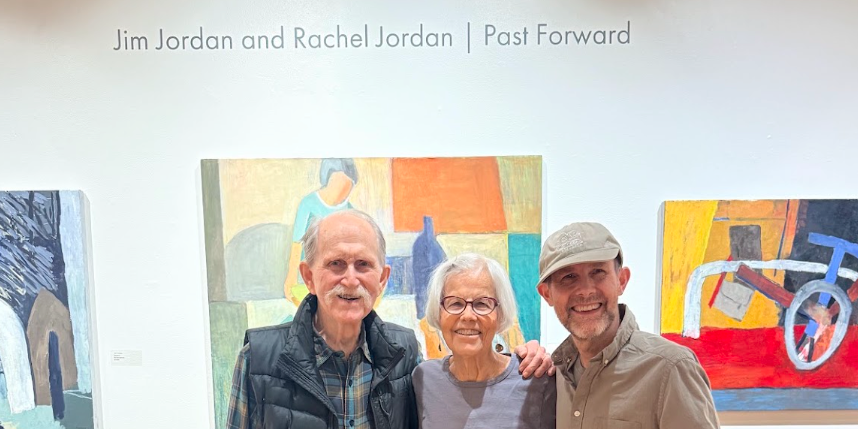
A Family of Artists: Meet Rachel, Jim, and Chris Jordan We were fortunate to host the entire Jordan family this month at AVA! Rachel, Jim, and their son, Chris, are a great example of art as a family affair! But what does that look like in practice? For The Jordans, it's a shared appreciation for art, the creative process, and the experiences that shape the way each of them sees the world. Rather than creating art as a singular unit, Rachel & Jim consider the family to be “three related artists each working separately on their own.” While they don’t share projects, they absolutely share an appreciation for creativity and even some influences! This family is a fine example of including artistic expression as a core family value. Beyond that, they’re impressive creatives, each in their own right. And our favorite reason for working with them is that they’re just really, really great people. We hope you enjoy getting to know them better, and be sure to stop by to see Rachel and Jim’s current exhibition, Past Forward , in our main gallery - on view now through November 14!  A History of Creativity The Jordans’ artistic roots extend well beyond the three of them. Rachel had several visual artists among her relatives on her father's side, while her sister initially studied art before pursuing a career in modern and ballet dance, eventually teaching at Hunter College in New York City. Jim's family also had its share of creative talent, including a sister who was a musical prodigy on piano, a mother who was a talented vocalist, and relatives interested in decorative arts. Both Rachel and Jim demonstrated an early aptitude for drawing and painting. For the Jordans, shared experiences also shaped creativity. As they explained, "All of our trips abroad (and many in the US) have focused on art and architecture." Many were also connected to Jim’s art history work. Their family's tradition of summer camping also helped cultivate a shared appreciation for the visual world of nature. Although each family member developed an individual creative practice, there was a common understanding that art required both imagination and dedication. Hard work, patience, and persistence were recurring values in their approach to their craft. A Family Portrait with Different Perspectives While the Jordans share an appreciation for the arts, they each have their own creative identity and process. Rachel and Jim share a studio and are familiar with each other's painting practices, but they’re also intentional about maintaining their individual creative spaces. As they explained, "We respect each other's privacy while working and only offer critiques on request." The couple’s artistic influences overlap in some areas, particularly their studies of early twentieth-century modernism. Both recognize the influence of Cézanne and the Cubists, including Picasso and Braque. Chris's creative pursuits took a somewhat different direction, spanning both photography and music. His interest in photography began with a home darkroom in the basement and eventually led him to graduate school and a career in higher education. He taught at Sage Colleges before becoming a tenured photography professor at the University of Alabama. In 2021, he published Nowhere in Place , a book featuring his work. Music had also been a consistent part of Chris's creative life. His early interests included trumpet, singing, and electric bass, with his focus shifting between music and photography over the years depending on his surroundings, work, and creative collaborations. Interestingly, the roots of his band, Eleventh-Hour Collective, which recently performed at AVA, could be traced back to high school, when he first played with the guitarist who was now part of the group. When asked whether his parents had ever inspired a song or another piece of art, Chris explained that the influence was often indirect and difficult to pinpoint. "Yes, but indirectly," he shared. "For me, inspiration can be a mysterious process; it's hard to pin down specific connections." He described creativity as a combination of memories, ideas, and associations that could unexpectedly come together in a tangible form. Sometimes, he recognizes familiar melodies, rhythms, shapes, or compositional elements in his work that may have been unconsciously influenced by people or other artists. Chris also shared a wide range of artistic and musical influences. In photography, he particularly enjoyed the work of Minor White and Carl Chiarenza, artists whose approaches to photography explored the sublime through subtlety. He also named Roni Horn, Hiroshi Sugimoto, and Gregory Crewdson among the artists who had influenced him. His musical influences were just as varied, including The Beatles, 1970s Miles Davis, Weather Report, Rush, Kate Bush, and David Bowie. Lessons from Each Other It’s clear that even though Chris has a wide variety of artistic influences, Rachel and Jim have also played a big role in the development of his artistic method. When asked what lessons his parents had taught him about art and life, Chris's answer was simple: patience and practice. "Patience and practice! It's important to learn the materials, methods and language of your craft," he explained. For Chris, developing technical ability is about more than mastering a medium. It’s about learning how to use it to translate inspiration into something tangible and, hopefully, relatable to an audience. He connected this idea to the Zen Buddhist concept of "chop wood, carry water," describing the creative process as something that required consistent effort and everyday practice. "Sometimes there can be dramatic fireworks of inspiration, but most often the process is a slow burn," he said. He saw a similar lesson in life itself, emphasizing the importance of showing up, living well, loving others, and remaining open and vulnerable. As he put it, "Living the day-to-day moments, showing up, living well, loving others, being open, vulnerable, not too armored and protective." It was a philosophy that echoed the values Rachel and Jim also recognized in their own artistic practices. When reflecting on the lessons art had taught them, they shared, "Patience and persistence are probably art's biggest 'life lessons.'" For Chris, the important part of being a creative person was developing the practice and technical skills necessary to be ready when inspiration arrived. He believes those moments can’t be forced. They might come as "a spontaneous gift from the muses, or after long hours of fruitless toil." Either way, the work was in being prepared to recognize and act on them. Favorite Memories For Chris, one of his favorite memories of family creativity went back to childhood and the family's tradition of making Christmas ornaments together. "This one's easier!" he said when asked about a favorite family creativity memory. One year, they cast plaster ornaments of Paris and painted them. Rediscovering those ornaments each year remained something he enjoyed, particularly because of the intricate painting and the family's collection of favorites. Some, he noted, were even a little hilarious. It was a simple tradition, but one that reflected the family's longstanding connection to making art and creating together. While Rachel, Jim, and Chris each follow their own creative paths, their stories shared common threads like having a deep appreciation for the art + the process, a willingness to put in the work to see their visions through, and an openness to be inspired by whatever an appreciation for art and its history, a willingness to put in the work, and an understanding that creativity was shaped by both the people and experiences around them.
By Lars Hasselblad Torres • September 21, 2026
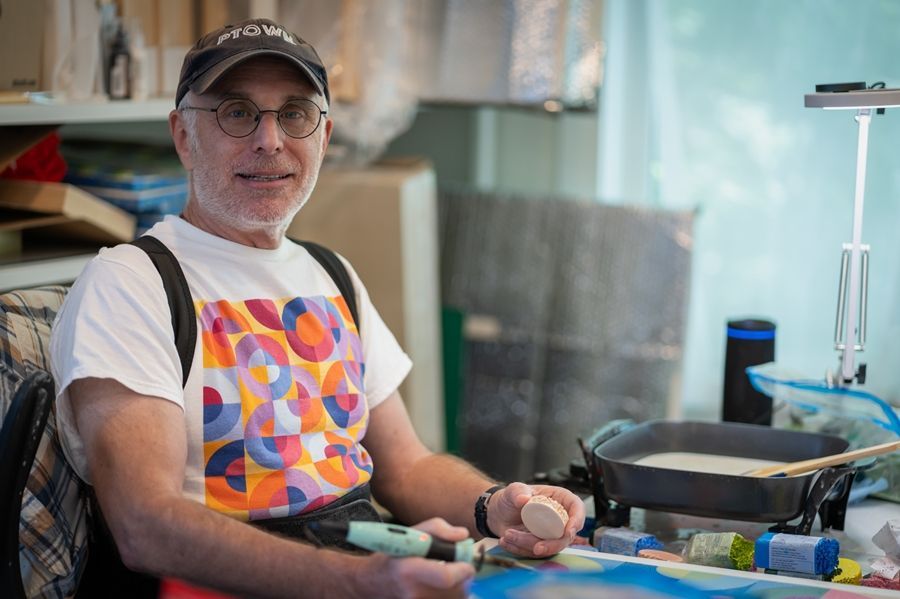
Photo of Ross Ozer in his studio by Jen Zee for the Provincetown Independent (2026)